
What Is Burrata? The Puglian Cheese With a Cream Centre, Explained

Burrata is on the Small Plates section of our Hamilton Road menu, printed as BURRATA DI PUGLIA — ashtray tomatoes, daikon salsa, basil oil. It is one of the few things on that card with no Japanese or Levantine name, and it is the dish people most often assume they already understand. Most people know it as “the soft one that oozes”. This post is the rest of it: what burrata actually is, how it is made, why it barely keeps, and the three different dates people give for its invention.
What burrata is, in one sentence
Burrata is a pouch of stretched-curd cheese — the same kind of curd as mozzarella — filled with shredded curd mixed with cream, and closed at the top. The outside is solid cheese. The inside is loose, rich and wet. Cut it and the centre runs; that is the whole point of the thing.
The filling has its own name. Stracciatella is shredded stretched curd mixed with cream, and the word is a diminutive of straccia, “rag” or “shred” — “a little shred”. Sold on its own, stracciatella is a cheese in a tub. Sealed inside a casing of the same curd, it becomes burrata. The name burrata itself is built on burro, the Italian for butter, which tells you what the Italians thought the inside tasted like.
How it is made
It starts like mozzarella. Warm milk is curdled with rennet; the curd is plunged into hot whey or lightly salted water, kneaded and pulled until it turns stretchy and stringy. That stretching step is what Italian cheesemakers call pasta filata, and it is what makes the casing possible.
While the stretched curd is still hot, it is shaped into an open pouch. The pouch is filled with the stracciatella and cream, then pinched closed at the top into the little gathered knot you see on a whole burrata. A 2020 study of the protected Andria cheese in the journal Foods describes the finished product as left to firm for twenty to thirty minutes in cold water once shaped, and typically weighing between 100 and 500 grams, seven to twelve centimetres across, with a smooth, shiny, milk-white surface and no rind. Traditionally a burrata was wrapped in asphodel leaves.
The same paper describes the cheese as generally made from pasteurised cow’s milk with calf rennet. That matters to one group of readers in particular, so we will say it plainly: traditional burrata is not a vegetarian cheese in the strict sense, because calf rennet is an animal product. If that matters to you, ask us before you order — our FAQ covers what else on the menu works for vegetarians.
Why it barely keeps
This is the fact that shapes how burrata is served everywhere. According to the same study, handmade burrata has a shelf life of three to five days; machine-formed burrata, filled with filtered compressed air during shaping, can last up to twenty. Even so, the recommendation it cites is to eat it within twenty-four hours of production to taste it at its best. Burrata is stored cold at around 4°C, but the paper also notes the traditional practice of warming it gently in a water bath before eating, for a creamier texture and fuller flavour.
The practical consequence for anyone ordering it in Singapore is simple: burrata is a fresh cheese, and freshness is most of what you are paying for.
Where it comes from — and the three dates
Burrata comes from Puglia, the heel of Italy, and specifically from the Murgia and the town of Andria. Everyone agrees on that. Nobody quite agrees on when.
- One account places its origin in the 1920s, as a way to use up leftover scraps of mozzarella curd rather than waste them — which is exactly what the filling is.
- Another places it around 1900, at the Bianchino brothers’ farm in Andria.
- A more recent account credits Lorenzo Bianchino of the Piana Padura farm with first developing it in 1956.
All three circulate, sometimes in the same article. We are not going to pick one. What is well documented is the official record that followed: Italy recognised burrata as a traditional agricultural product of Puglia by ministerial decree in 2002, and in 2016 “Burrata di Andria” was registered as a Protected Geographical Indication under EU Regulation 2016/2103, which requires the whole process to take place in Puglia.
The waste-saving origin story is the one we like best, for reasons that will surprise nobody who has read our post on how our own kitchen runs on minimal wastage: a cheese invented to stop good curd going in the bin is our kind of cheese.
Burrata, mozzarella and stracciatella: the difference
- Mozzarella is stretched curd, shaped and solid all the way through.
- Stracciatella is stretched curd shredded into rags and mixed with cream — loose, spoonable, no casing.
- Burrata is the first wrapped around the second.
If you like the centre of a burrata more than the outside, stracciatella is the cheese you actually like.
What “di Puglia” on our menu means — and what it does not
Our menu says Burrata di Puglia: burrata from Puglia. It does not say “Burrata di Andria”, the protected name, and the menu does not name a producer, so we are not going to claim a PGI label or a particular dairy here. If you want to know where this week’s came from, ask the team at the table.
The same goes for the plate. The menu prints ashtray tomatoes, daikon salsa, basil oil and stops there, and we are not going to embroider what “ashtray tomatoes” means in a blog post when the kitchen can tell you in person. What we can say is where the dish sits: daikon, the Japanese white radish, is the part of the plate that belongs to the other half of our menu, and a sharp, crunchy salsa is a sensible thing to put next to something as soft and rich as burrata. The burrata has survived more than one menu change — our round-up of what reviewers keep ordering notes that the plate around it has changed since the older reviews were written.
What to drink with it
Rich, fresh dairy wants acidity or a bit of texture, not tannin. Our wine list is unusual in Singapore for how much Macedonian wine is on it, and in that post we suggest the Skovin Chardonnay Barrique (W6) where you would normally reach for a white Burgundy, with the burrata named as one of the dishes it suits. If you are starting the meal with mezze, the burrata is a good bridge between the dips and the grill — our guide to ordering the mezze board explains how the table usually builds.
Where to try ours
Burrata di Puglia is on the Small Plates section of the Habibi-san menu at 29 Hamilton Road, Jalan Besar, Tuesday to Sunday, 5pm to 11pm. Habibi-san serves pork and alcohol and is not halal. For more of the dishes and ingredients behind our menu, the five-year timeline of Habibi-san links to every one of them, and our recent explainers on sumac and the muhallebi are in the same series.
Book a table, order it early, and eat it while it is still at its best — which, as the cheesemakers of Andria would tell you, is now.
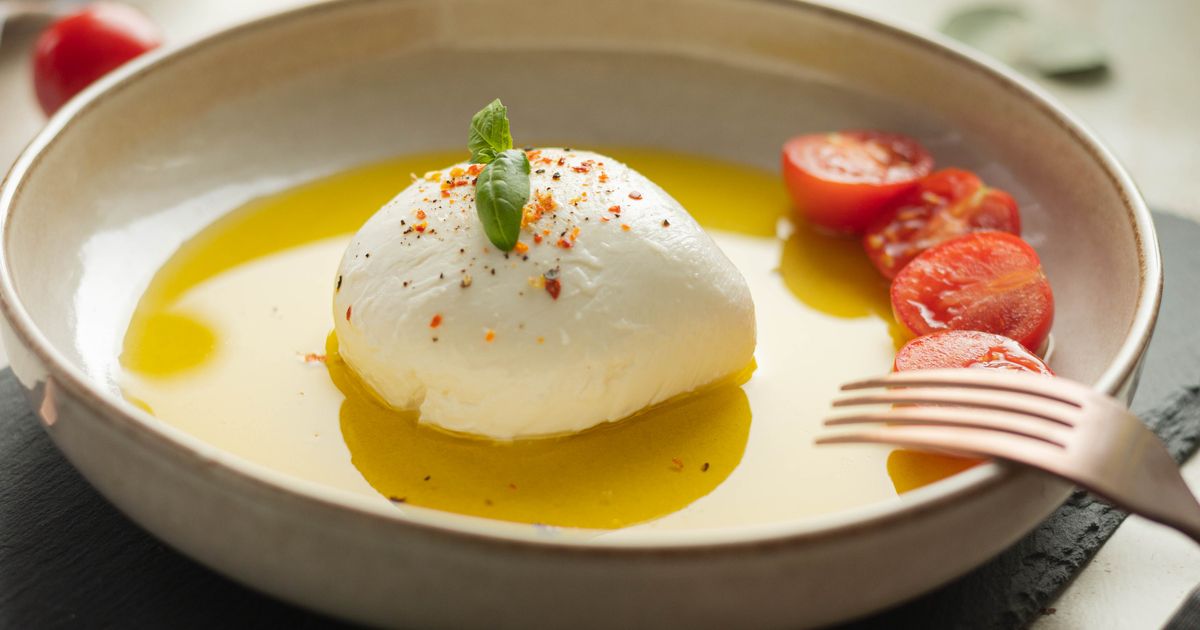
About the photo above: it is a stock photograph of a burrata, not our plate. Ours comes with ashtray tomatoes, daikon salsa and basil oil.
Sources: Habibi-san food menu (live PDF, re-read 30 September 2026); “‘Burrata di Andria’ PGI Cheese: Physicochemical and Microbiological Features”, Foods 9(11), 1694 (19 November 2020); English Wikipedia, “Burrata” and “Stracciatella (cheese)”. No quotation in this post is attributed to anyone.