
Konro Grills 101: The Little Japanese Firebox, Explained

If you have ever looked at a yakitori counter and wondered why the grill is a long, narrow, pale-coloured box that looks like it was cut out of a block of chalk, this is the answer. That box is a konro, and the strangest thing about it is that the interesting part is not the fire. It is the walls.
We do not cook on one — a restaurant grill line is a different animal, and we will come to that honestly at the end. But konro are the reference design for charcoal cooking at small scale, they explain a lot about why Japanese grilling looks the way it does, and they are the thing most people should actually buy if they want to try this at home.
What a konro is
A konro is a small charcoal brazier: an open-topped box, usually rectangular and much longer than it is wide, with a bed for coals at the bottom, adjustable air vents at the front, and a removable metal grate or mesh across the top. There is no lid, no thermostat and no moving parts.
The proportions are not aesthetic. A long, narrow trough is exactly the shape of a row of skewers laid across it, and the width is set so that the food sits over the coals while the skewer handles rest on the cool rim outside the fire. That single geometric decision is why the format exists, and it is the reason a konro is a poor substitute for a barbecue and an unbeatable tool for skewers.
A note on names, because the internet is careless with them. You will see the same object sold as a konro, a shichirin, a yakitori grill and, in America, a hibachi. The words overlap and are used loosely in English. What matters practically is the description rather than the label: a diatomite-bodied open trough with vents is the thing being discussed here, whatever the box says.
The material is the entire point
A konro is made of diatomaceous earth — diatomite. It is a sedimentary rock formed from the fossilised shells of diatoms, microscopic algae that sank to the seabed in enormous numbers over a very long time. The shells are almost pure silica and full of microscopic voids, which gives the rock two properties that matter enormously here: it is very light, and it is a poor conductor of heat.
That poor conduction is the feature. A steel firebox radiates heat outwards in every direction, which is heat you paid for and are not cooking with. A diatomite wall holds the heat inside the trough and sends it upwards through the food, and the outside of the grill stays cool enough that the thing can sit on a counter in front of guests. A konro does more with less charcoal than a metal grill of the same size, and the reason is a rock made of dead plankton.
Where they come from, and how they are made
Japan’s diatomite comes chiefly from the Noto peninsula in Ishikawa prefecture, with some from Hokkaido. Suzu, at the northeastern tip of Noto, is the country’s largest producer and the traditional centre of the craft.
There are two manufacturing methods, and the difference shows up in the price:
- Kiridashi — carved. Blocks of diatomite are cut from the mine and shaped by hand into a grill, in one piece, then kiln-fired. Knifewear, which imports them, puts these at roughly two to three times the price of the alternative, and rates them as more durable because there are no joins.
- Nerimono — moulded. The diatomite is ground, mixed with water, cast into moulds, baked into blocks, and the blocks assembled into a finished grill. Faster, cheaper, available in larger sizes, and by the same account it performs equivalently.
The best-known maker in the West is Kaginushi, which has run a diatomite mine and a konro workshop on the Noto peninsula since 1932.
It is worth knowing that this is a fragile supply chain attached to a real place. The earthquake of 1 January 2024 struck with a magnitude the Japan Meteorological Agency put at 7.6 and the USGS at 7.5, with its epicentre about six kilometres from Suzu itself. The town that makes most of Japan’s diatomite was effectively at the centre of it. If a konro seems expensive or slow to arrive, that is part of the reason.
Living with one
Four things nobody tells you before the box arrives.
Lighting. If you fill it with binchotan and hold a match to it, nothing will happen. White charcoal has a high ignition point and needs a chimney starter, a gas ring or an existing fire to get going. Black lump lights readily. The difference between the two is worth five minutes of your time before you buy fuel.
Control. There is no dial. You have the vents, the depth of the coal bed, and the option of moving food to a cooler end. Heat management on a konro is a physical skill, which is the same thing that makes an open fire the hardest station in any kitchen.
Ventilation, and this one is serious. Burning charcoal produces carbon monoxide, which has no smell and gives no warning. A konro is a charcoal fire in a small box, not an appliance, and it belongs outdoors or under proper extraction. Never use one in a closed room.
Handling. Diatomite is light, porous and brittle. It will crack if dropped or soaked, and cheap moulded grills can split along their joins over time. Treat it like the piece of fired earth it is.
What we cook on instead, and why
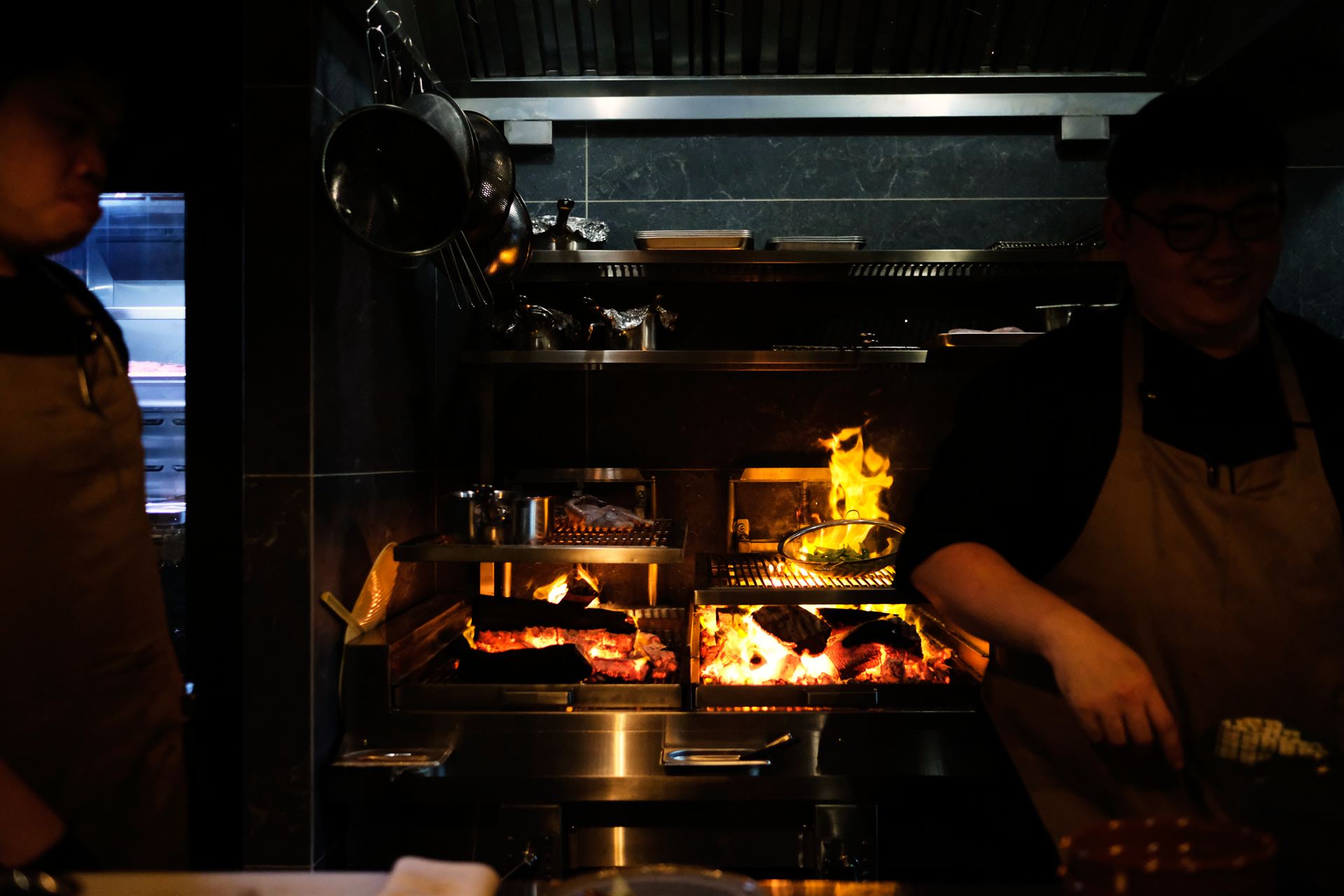
Our grill at Hamilton Road is not a konro and we would not want it to be. The photograph above shows what it actually is: a steel line with two open fire beds, wood burning alongside the charcoal in that frame, and heavy grates that can be raised and lowered over them. (Updated 7 October 2026: the charcoal we grill over is binchotan. One photograph cannot tell you which point in a service, or which stage of building the fire, it caught.)
The reason is the menu. A konro is optimised for many small identical things cooked quickly at a fixed height. We have to put a whole spatchcocked bird, a chop, a fish and a tray of vegetables over fire in the same service, and those want different distances from the coals rather than different skewers. Height adjustment is the feature we cannot do without, and it is the feature a konro does not have. Our smaller sister room on Haji Lane, which cooks skewers, is the side of the business a konro’s logic actually fits.
Neither design is better. They are answers to different menus, which is the honest version of almost every equipment argument in cooking.
We are at 29 Hamilton Road in Jalan Besar, Tuesday to Sunday, 5pm to 11pm, with brunch on Saturday and Sunday from 11am to 2.30pm. We serve pork and alcohol and are not halal; the FAQ handles the practical questions. If skewers are what brought you here, there is the guide to the Japanese grill tradition and Li’l Habibi itself; for the wider map, the full guide to Japanese food in Singapore. Otherwise: the menu, the room and the grill, and a table.