
Binchotan vs Regular BBQ Charcoal: What It Actually Does to the Flavour

Ask what binchotan tastes like and you will get two confident answers. One says it is the secret behind every good yakitori counter in Tokyo. The other says charcoal is charcoal and you are paying for a story. Both are wrong, and the interesting part is how they are wrong.
We run an open fire for a living, so this is the comparison written from the fuel tray outwards: what is actually in each bag, which differences can be measured rather than felt, and where the fuel sits in the list of things that decide how a piece of grilled food tastes. The physics of grilling versus pan-cooking is a separate post, and so is the price question. This one is only about flavour.
“Regular BBQ charcoal” is two completely different products
Before you can compare anything to binchotan you have to notice that the thing you are comparing it to is not one thing.
Lump charcoal is wood that has been carbonised and then broken up. Irregular pieces, visible grain, sometimes a recognisable bit of branch. Nothing is added to it.
Briquettes are the uniform pillow-shaped pieces most of the world buys. They are made from charcoal fines and other material, bound together and pressed into shape. They are a manufactured product in a way lump is not.
That distinction matters more than most binchotan-versus-charcoal arguments do, because the gap between lump and briquette is a gap in composition, and the gap between lump and binchotan is mostly a gap in degree.
What is in a briquette, according to the people who make them
Here is where it gets genuinely interesting. Kingsford is the largest briquette brand in the world. Its own website says its charcoal is made with “locally sourced wood and other natural ingredients”, by a process that “includes carbonizing wood, blending with natural binders, and pressing into briquets”.
Read that again. It tells you there are binders and other ingredients; it does not tell you what either is. There is no ingredient list anywhere on the site. We went looking for one specifically to quote here, and it is not published.
We are not suggesting anything sinister; briquette binders are ordinarily starches. The point is narrower and it is about evidence: if you want to know what is burning under your food, lump charcoal answers the question and a briquette bag mostly does not. One of the two is a single ingredient. The other is a recipe you are not shown.
The exception is the self-lighting kind, and there the manufacturer is upfront: Kingsford’s own FAQ says those products “contain a lighting agent that evaporates if the bag is left open or torn”. That is a chemical you are buying on purpose, and we will come back to it, because it is the single biggest flavour variable on this whole page.
The one difference that is actually measured
Binchotan’s reputation is that it contributes almost no flavour of its own. That sounds like folklore. It is not, and the reason has a name: volatile matter.
Volatile matter is everything in a piece of charcoal that is not fixed carbon or ash. It is the leftover tarry, resinous, partly-cooked fraction of the original wood. When you light charcoal, the volatile fraction is what comes off as smoke. Smoke is flavour. Less volatile matter, less smoke, less fuel flavour on the food.
Japanese forestry research has been comparing the two families on exactly this axis for a very long time. A 1954 study in the Journal of the Japanese Forestry Society by Kishimoto, Unrin’in and Shigeno, working on the ignition point of Japanese charcoal, sets it out plainly: shirozumi (white charcoal), carbonised at high temperature, is high in alkalinity and contains little volatile matter, while kurozumi (black charcoal), carbonised at low temperature, is low in alkalinity and contains much volatile matter. The same paper reports what follows from it, which is that black charcoal generally ignites at a lower temperature than white.
So the folklore is right and it is right for a physical reason. Binchotan tastes of less because there is less in it to taste. (The white-and-black distinction underneath all this takes about five minutes to learn,.) Black lump charcoal contributes more smoke because it has more left in it to give off. Neither of those is a fault. They are two settings on the same dial, and a kitchen picks the one that suits what it is cooking.
The variable nobody mentions, which beats all of them
If a piece of grilled food has ever tasted faintly of a petrol station, the fuel was not the culprit. The lighting was.
Charcoal lighter fluid is, as Wikipedia’s summary of the product has it, “either petroleum based (e.g., mineral spirits) or alcohol based (usually methanol or ethanol)”, and it “may impart an unpleasant flavor to food cooked upon fires lit with it”. It is regulated as an air-quality problem in some places — Southern California’s air district has a rule governing what may be sold as charcoal lighter fluid — for the same reason it is a flavour problem everywhere: it evaporates, and what evaporates has to go somewhere.
The fix is not exotic. Wait. A fire lit with fluid needs the flames to die back and the coals to grey over before anything goes on the grate, because until then you are cooking in unburnt solvent. A chimney starter, which lights charcoal with nothing but newspaper and airflow, removes the problem at the source. This one decision will change how your food tastes more than any choice between bags.
The honest ranking
Put in order of how much each one changes what arrives on the plate:
- The food’s own fat. Fat drips, hits the coals, vaporises and comes back up through the food. That circuit is most of what people mean by “it tastes grilled”, and it is the ingredient seasoning itself rather than the fuel seasoning it. We have made this argument at length and will not repeat it here.
- Fire management. How hot the bed is, how far the food sits from it, whether it is moved. A grill has no dial. This is the whole skill.
- How the fire was lit. See above. Fluid, badly handled, will outshout everything.
- The fuel. Real, measurable, and fourth.
That fourth place is not an argument against caring which charcoal you buy, but for caring in the right way. Binchotan is bought for control and neutrality over a long service, not for a flavour it adds. Black lump is bought for a fierce bed, a fast light and a bit of smoke in the bargain. A briquette is bought for consistency and price, and the price of that consistency is not knowing exactly what is in it.
What we will and will not claim about our own fire
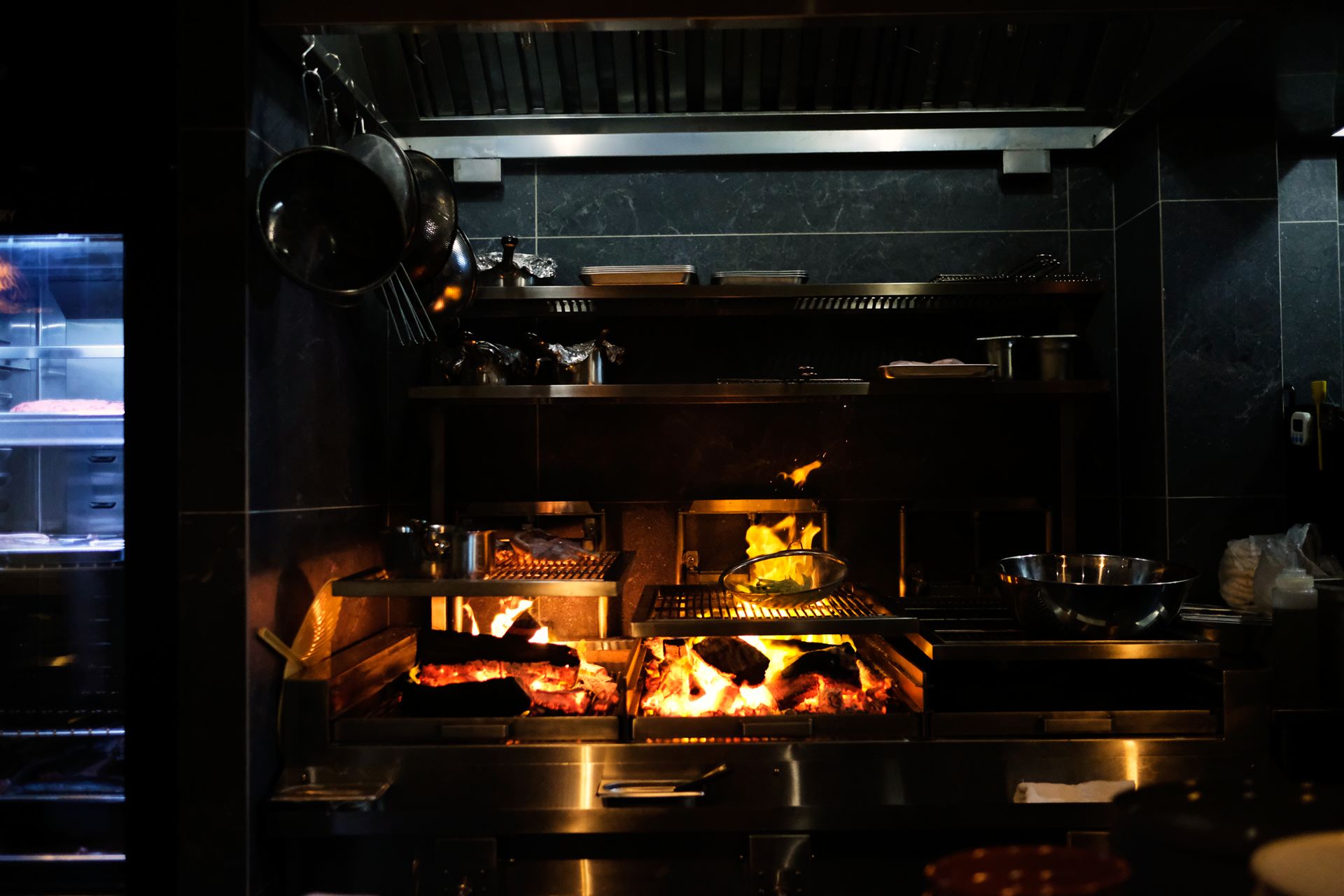
Our site describes us as a charcoal grill and our menu names charcoal exactly once, on the Lebanese charcoal chicken. Neither the site nor the menu names a fuel. Our kitchen does: we grill over binchotan. (Updated 6 October 2026. This section used to decline to say, because nothing published by us said so; the kitchen has since confirmed it, and we would rather tell you than keep hedging.)
The photograph above is worth being straight about, because it does not show that. What is burning in it is wood and dark lump fuel with open flame, not the pale grey sticks binchotan is. One frame cannot tell you whether it caught the fire being started, a different section of the grill or a different night, so we are not going to build a story on it either way.
What we will claim is the thing this post has been building to: if you eat something of ours that tastes of fire, that flavour came out of the ingredient, not out of the bag. That is true of every good grill, and it is why the fuel argument is worth understanding and then holding lightly.
We are at 29 Hamilton Road in Jalan Besar, Tuesday to Sunday, 5pm to 11pm, with brunch on Saturday and Sunday from 11am to 2.30pm. We serve pork and alcohol and we are not halal; the practical questions are answered in the FAQ. If you want the wider picture, start with the full guide to Japanese food in Singapore, or read about what the skewer tradition does with the same fire. Otherwise: the menu, the room and the grill, and a table.