
Charcoal 101: Binchotan, Smoke and Why Fire Beats the Pan
Charcoal does not beat a pan because of smoke. It beats it because of how the heat arrives. Here is what binchotan is, what black charcoal does differently, and what fire is genuinely bad at.

Most explanations of charcoal cooking start and end with the word smoky, which is the least interesting thing about it and, in the case of the best Japanese charcoal, close to the opposite of the truth.
We have built a restaurant around an open fire, so this is the explainer we would have wanted: what binchotan actually is, why the difference between a grill and a pan is not really about flavour at all, and what fire is genuinely bad at. Skewers as a format have their own post; this one is about the fuel and the physics underneath.
The real difference is how the heat arrives
A pan cooks by conduction. Metal touches food, and heat moves across the contact.
A bed of coals cooks mostly by radiation — infrared travelling across a gap, arriving without anything touching anything. That sounds like a technicality. It produces three differences you can taste.
One: browning can start while the surface is still wet. In a pan, a wet surface has to boil dry before it can brown, because almost all the energy goes into evaporating water first. That is why a crowded pan steams food instead of searing it. Radiant heat from coals is intense enough to drive that off and start browning nearly at once, which is why a grilled surface can be properly caramelised while the inside is barely touched.
Two: nothing sits in its own liquid. Food on a grate is suspended over a gap. Whatever comes out of it — water, fat, marinade — leaves. In a pan it pools, drops the temperature, and quietly boils the underside of the thing you were trying to sear.
Three, and this is the one with no equivalent anywhere else: the food seasons itself. Fat drips out, lands on the coals, vaporises, and comes straight back up through the food as smoke. The flavour is not coming from the fuel. It is the ingredient’s own fat, returned to it in a different form. It is the only cooking method where that circuit exists, and it is the actual reason a grilled chop and a pan-cooked chop are two different foods.
So what is binchotan?
Binchotan is Japanese white charcoal, traditionally made from ubame oak and associated above all with the Kishu region. It is the reference standard for grill fuel and it is genuinely different from what most people picture when they hear charcoal.
The making is what does it. The wood is carbonised slowly, then the kiln temperature is driven right up at the end, and the glowing pieces are raked out and smothered in a damp mixture of ash, sand and earth. That rapid smothering is what leaves the pale coating the name refers to — the charcoal is not white inside, it is jet black. The result is extraordinarily dense and hard. A piece of binchotan struck against another piece rings rather than thuds.
Dense fuel burns slowly, steadily and for a very long time, at high heat, with very little flame and very little smoke. And here is the part that surprises people:
Binchotan is prized for contributing almost no flavour of its own.
Everything the marketing of Western barbecue teaches you says charcoal is a flavour ingredient. In the Japanese grilling tradition it is the opposite: the fuel is chosen to be as neutral and as controllable as possible, so that what you taste is the ingredient, its own fat, and the seasoning. Buying the most expensive charcoal in the world in order to taste less of it is a very Japanese piece of logic, and once you see it you understand a lot about how an izakaya grill section is put together.
Black charcoal, white charcoal, and what is actually in most grills
The other family is black charcoal — lump charcoal, made the way most of the world makes it, fired at lower temperatures and quenched rather than smothered. It is softer, lighter, easier to light, cheaper, and it burns faster and hotter at the start before fading. It also throws more smoke, which means it does contribute flavour.
Neither is better. They are tools for different jobs. Binchotan is what you want for a long service of small items where consistency over four hours matters more than anything. Black lump is what you want when you need a fierce bed quickly, and when a bit of smoke in the flavour is welcome rather than a fault.
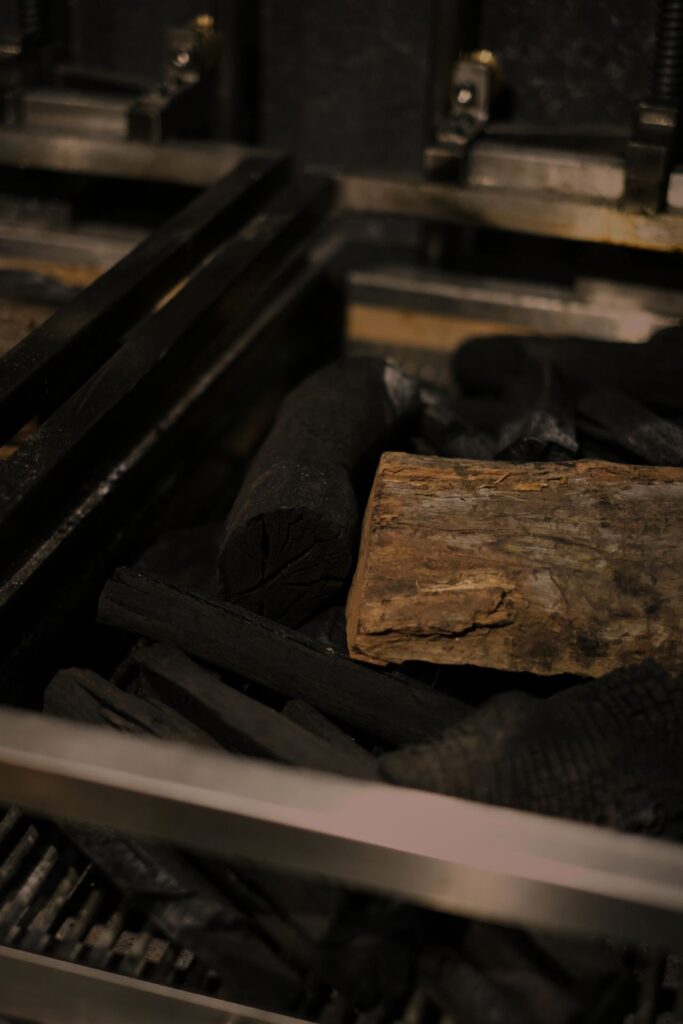
Which brings us to the photograph above, because it is our own fuel tray and we would rather show it than describe it vaguely. What is in it is black lump charcoal, with a piece of wood resting on top. Binchotan is pale grey, and it is not what you are looking at. One frame cannot tell you whether it caught the fire being lit, a different grill or a different night, so we are not going to build a story on it.
What we can tell you plainly is what we grill over: binchotan. When this post was first written we declined to say so, because our own website only ever said “charcoal grill” and we did not want to lean on a word we had not published. That has now been confirmed by the people who run the kitchen, and the photograph above is still the honest one we have, so it stays with this note rather than being swapped for someone else’s picture of white charcoal. (Updated 5 October 2026.) Why binchotan costs what it does is a separate story, and it has its own post.
What fire is genuinely good at
Four categories, and they are not the four you would guess.
- Fatty cuts. The self-basting circuit above only works if there is fat to drip. This is why a pork collar and a well-marbled beef cut are transformed by coals and a lean chicken breast mostly is not.
- Whole and large things. Radiant heat penetrates without needing full contact, so a flattened whole bird cooks evenly in a way it never would face-down in a pan. Our menu labels the Lebanese charcoal chicken (45MINS OF LOVING), which is an honest statement of what that takes.
- Vegetables, more than most people expect. Anything with sugar in it and enough surface area gets a char you cannot reproduce indoors. Brussel sprouts are the obvious case; so is an eggplant taken far past what looks reasonable, which is the entire foundation of babaganoush.
- Bread. Flatbread on a grate puffs, blisters and takes on char in under a minute. Every charcoal culture has bread at the fire for exactly this reason, and it is why pita belongs next to the mezze rather than in a basket from the kitchen.
What fire is bad at, which nobody writes down
A grill is a poor instrument for a lot of cooking, and pretending otherwise would be the kind of overclaim this blog tries to avoid.
It cannot hold a temperature. There is no dial; there is a bed that is hotter in some places than others and cooler than it was twenty minutes ago, and control means moving food around it and knowing the bed. That is a skill, not a setting, and it is why an open fire is the least forgiving station in a kitchen.
It is useless for anything emulsified or delicate. A beurre blanc is a stove job. So is toum. So is anything that needs to be held at a precise temperature without moving. A restaurant built entirely on charcoal with no stove would be a restaurant with a very short menu.
And it is expensive in the boring ways. Fuel gets consumed whether or not the orders come in. Somebody has to be at the grill all night. A mistake cannot be hidden under a sauce, because the point of the method is that there is nothing between the food and the fire. That combination is a decision about what kind of kitchen you want to be rather than a way to save money, and it is part of what we mean by fun dining rather than fine dining.
How to taste the difference for yourself
Order one thing that has been over coals and one thing that has not, in the same sitting, and pay attention to the edges rather than the middle. The grilled thing will have a boundary — a band of char, then a band of cooked, then the interior. The pan-cooked thing will have a surface and an inside and much less in between. That boundary is the whole argument.
Then order something smoked rather than grilled, because they are not the same thing and the difference is instructive. Smoke applied to something small and cold is a seasoning technique; fire applied to something large and raw is a cooking one.
We are at 29 Hamilton Road in Jalan Besar, Tuesday to Sunday, 5pm to 11pm, with brunch Saturday and Sunday 11am to 2.30pm. We serve pork and alcohol and are not halal; the practical questions live in the FAQ. If you would rather let the grill section decide for you, FEEEEED ME! is how that works, and if you are working out how late the fire runs across the city, that is a separate and slightly depressing survey. For the wider map, start at the full guide to Japanese food in Singapore, or read how the two halves of our menu fit together.
Otherwise: the menu, the room and the grill, and a table.