
Mangalica Pork Collar: Why We Grill the Fattiest Cut of a Fatty Pig
Mangalica is a pig bred to be fat. Why we grill the collar and not the loin, what tonkotsu jus is doing on a Middle Eastern menu, and how to order the chop.

The pork collar is the richest thing we cook, and it is also the dish most likely to reach you through an out-of-date description. Older reviews describe an Iberico chop from our Haji Lane years; the Hamilton Road menu runs a Mangalica pork collar chop, and we have already sorted out that confusion in what reviewers keep ordering. This piece is about the dish that is actually on the pass.
The full menu line: Mangalica pork collar chop & beans — fennel spice, wasabi & butter bean mash, charred vinegared radicchio, tonkotsu jus. Every part of that is arguing with the fat.
Mangalica is a pig bred to be fat
Mangalica is a Hungarian breed developed in the nineteenth century, crossed together from old Hungarian pig races and pigs of Mediterranean origin. It grows a thick, curly fleece — it genuinely looks more like a sheep than a pig — and it is what the literature calls a fatty-type breed, with high intramuscular fat.
That phrase is the whole point. Modern pork is dominated by a handful of lean commercial breeds, selected over decades for exactly the opposite quality: more muscle, less fat, faster. Mangalica went the other way and was nearly left behind for it. It survives now as a rare local breed with a niche role in the market, which is a polite way of saying it is expensive and inconvenient and people keep buying it anyway.
What you taste is fat inside the muscle rather than only around the edge of it. A lean chop cooks from the outside and dries from the inside. A heavily marbled one bastes itself the entire time it is over the fire, and the fat carries flavour that lean protein simply cannot hold.
Why the collar and not the loin
Given a whole pig, the loin is the obvious cut and the wrong one for us. It is lean, uniform, tidy on a plate and completely unforgiving: it has a window of about a minute where it is right, and on either side of that window it is raw or it is dry.
The collar is the muscle that runs up the neck and shoulder. It works hard while the animal is alive, which means it is threaded with fat and connective tissue rather than being a clean block of protein. Over live fire that is an enormous advantage. Fat renders slowly and keeps the meat wet while the outside takes on char, connective tissue softens instead of tightening, and the cut arrives at delicious over a span of several minutes rather than several seconds.
Put a fatty breed and a fatty cut together and you get the most forgiving thing on the grill and the most flavourful. That is not a coincidence, and it is not a coincidence that it is the one we put on the menu. We built a kitchen around an open charcoal fire and then chose the cuts that reward it.
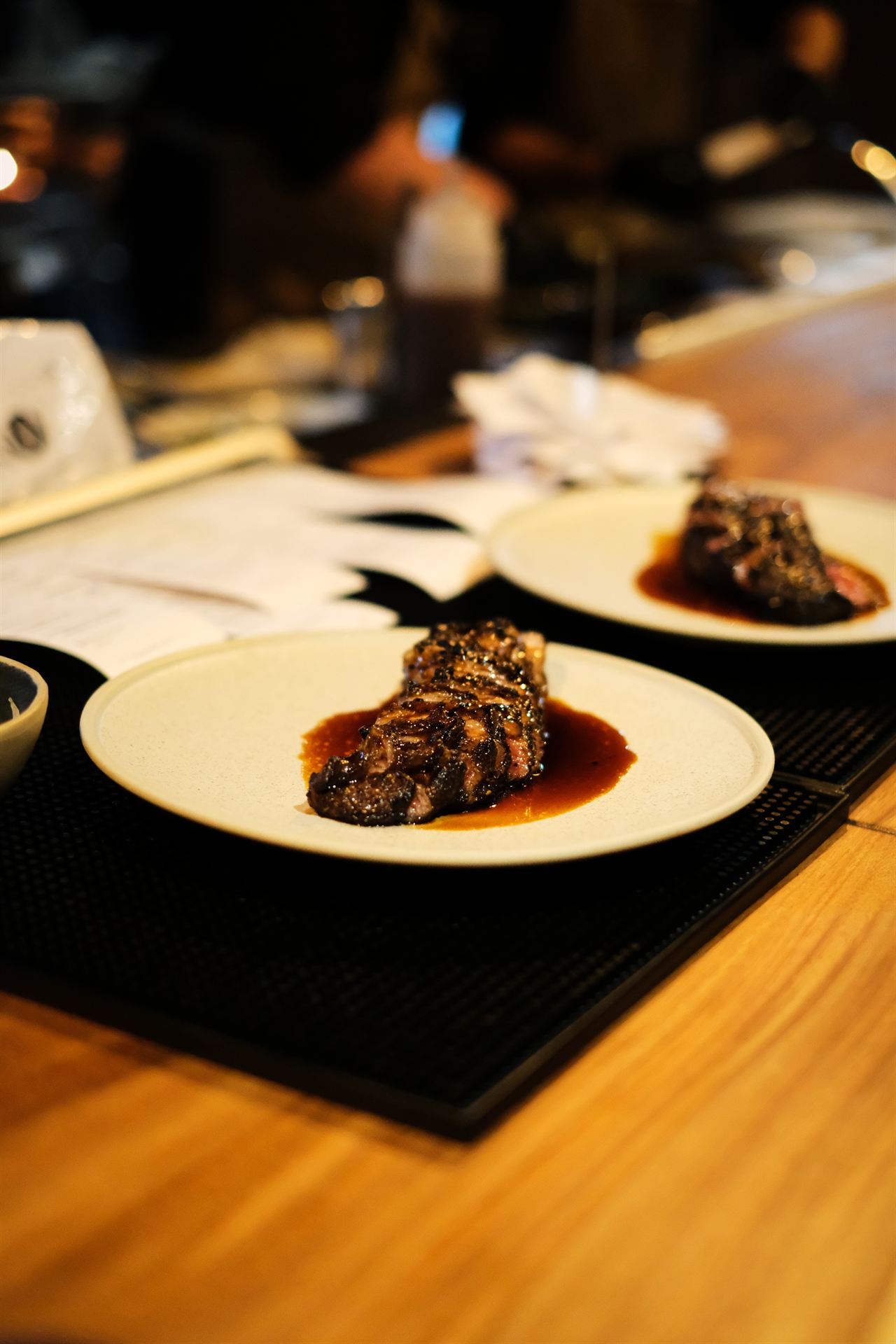
Tonkotsu jus, on a menu that looks Middle Eastern
This is the component that makes people look twice, so it is worth explaining properly.
Tonkotsu means pork bone. It is the base of the Hakata style of ramen from Fukuoka, and the reason that broth is opaque and white rather than clear is that the bones are boiled hard and long enough to emulsify collagen, marrow and fat into the water. It is not a delicate stock. It is a deliberately violent one, and its whole character is pork concentrated into liquid.
We reduce that idea into a jus and put it back on the pig it came from. Pork sauced with pork is old logic, not clever logic — the French do it, the Chinese do it, and it works because nothing tastes more like an animal than the animal’s own bones. It also fits how we run the kitchen generally, which is with as little going in the bin as we can manage; that is a longer story and it is told here.
The fusion, such as it is, is not a stunt. A Japanese pork-bone reduction sitting next to fennel and radicchio is not two cuisines colliding. It is one sauce doing the job a sauce does.
The other three things on the plate
Fat is delicious and fat is exhausting, and a rich main that gives you nothing to push against is a plate you stop eating halfway through. Everything else on this one exists to stop that happening.
Fennel spice. Anise against pork fat is one of the oldest pairings in Mediterranean cooking — it is the reason porchetta tastes the way it does. Fennel does not cut richness so much as reframe it, giving the fat a cool, sweet, slightly medicinal edge to sit against.
Wasabi and butter bean mash. Butter beans are Levantine and Mediterranean home cooking; wasabi is the Japanese hinge. Practically, the mash is there to catch the jus so none of it is wasted on the plate. Flavour-wise, wasabi heat is short and clean and goes up into the nose rather than sitting on the tongue, which is exactly the kind of heat that survives next to a lot of fat.
Charred vinegared radicchio. The most important item on the list. Radicchio is properly bitter, the vinegar brings acid, and the char adds a third kind of edge. Bitter and sour are the two things a fatty chop is always asking for, and this is both at once.
Read the plate from that angle and it stops looking like a fusion exercise and starts looking like a single argument: here is a very rich piece of pork, and here are three separate defences against it.
It is pork, and we are not halal
Worth stating plainly on a menu with this much Middle Eastern language on it: we serve pork and we serve alcohol, at both venues. This chop is the clearest example at Hamilton Road, and Li’l Habibi runs Iberico pork jowl, mortadella and loaded pork nachos. Habibi-san is not halal and has never been presented as such. If that matters to you, better to know it here than at the table — the rest of the practical questions are answered in our FAQ.
How to order it
The chop sits under Biggies, which is our word for the plates that anchor a table rather than circulate around it. The way it works best is late: mezze first, then the chop, shared, with the dips still on the table so there is something sharp to go back to between mouthfuls.
Do not order it alongside another rich main. Order it alongside acid and char — the Brussel sprouts and the babaganoush are both built to sit next to it, and neither will make you regret the second half of the chop. If you would rather hand the whole decision over, FEEEEED ME is the chefs’ selection and it exists precisely for tables that have stopped choosing.
What an evening here tends to cost, honestly, is set out here. The full list is on the menu, the fire it comes off is in the gallery, and the story of how the chop changed pigs between one address and the next is part of the move to Hamilton Road and of five years of Habibi-san.
We are at 29 Hamilton Road, Singapore 209198, Tuesday to Sunday from 5pm. Book a table.
If somebody at the table is not eating pork, the other big plate to know about is the Atlantic seabass — yuzu beurre blanc, miso butter, and a skin the menu promises will be crisp.