
From Kebab Skewer to Yakitori Stick: Two Traditions, One Fire

Both of our kitchens cook meat on a stick over fire, and they inherited the idea from opposite ends of the same continent. On a plate the two look like the same object. They are not doing the same job.
This is a comparison rather than a definition. The vocabulary — kushi, yaki, yakitori, kushiyaki — and our own skewer list with prices are in our guide to skewers and the Japanese grill tradition. This post picks up the sentence that guide deliberately refused to make a fuss about: two languages, two continents, one word for a pointed stick.
One of these traditions has a thousand-year paper trail
The firm end of the Middle Eastern record is a cookbook. Ibn Sayyar al-Warrāq’s tenth-century Baghdad compendium Kitab al-Tabikh describes kabāb as cut-up meat, either fried in a pan or grilled over a fire — not “on a skewer” at all. The skewer came to dominate the word later.
Older claims exist and we pass them on as claims: Homer’s Odyssey describes skewering strips of meat for broiling, which the food historian Clifford A. Wright reads as an early shish kebab, and kebab-like cooking is attributed to Minoan Crete in the seventeenth century BC. Attributions, not receipts.
Japan’s side is much younger, and the reason is on the record. In 675, Emperor Tenmu issued an edict prohibiting the eating of the meat of cows, horses, dogs, monkeys — and roosters. The chicken is named in the list. Meat never actually disappeared; deer and wild boar are recorded through the medieval period into the sixteenth century. But the food culture built itself around the absence, and the ban on red meat was not formally lifted until 1872, when Emperor Meiji ate beef as part of Japan’s opening to the West. Ten monks are recorded as attempting to break into the Imperial Palace over it.
So fire and skewers are ancient in both places, but a shop whose entire business is chicken on sticks is a modern Japanese institution — and given that edict it could hardly have been anything else. When people call yakitori ancient, they are borrowing age from the equipment and lending it to the format.
Both traditions named the equipment. Only one named the animal.
Şiş is Turkish for a skewer, and also for a sword. That double meaning is the source of the tradition — and it is a tradition rather than a document — that soldiers grilled meat on their swords over open-field fires.
Kebab itself is older and less tidy. The etymologist Sevan Nişanyan traces it to the Akkadian kabābu and the Aramaic kbabā, with meanings in the region of burning and frying. The Persian dictionary of Dehkhoda offers two possible roots for şiş: the word for six, on the reading that six pieces of meat make a standard skewer, or a Late Middle Persian word sich, meaning skewer.
Take whichever you prefer; the naming instinct is identical to the Japanese one. Kushi is the stick, yaki is the fire, and neither culture named this food after the animal — because the animal was the variable and the fire was the constant. Which makes yakitori the odd word out in both families, since tori is bird. It is the one name in the whole vocabulary that tells you what you are eating, and it could afford to be that specific because it was naming a modern format rather than an ancient technique.
What actually goes on the stick, and the myth sitting in the middle
Here is the thing most people have backwards. In Turkey, shish kebab does not normally contain vegetables — they may be cooked on a separate skewer alongside. The alternating meat-pepper-onion arrangement the word conjures in a Western supermarket is a Western preparation.
The hardware varies by purpose. Adana kebabı is hand-minced meat mounted on a wide iron skewer — a structural member, because minced meat has nothing else holding it together. Persian kababs run on long, thin metal skewers. In both cases the stick is doing engineering.
The Japanese skewer solves a different problem. One part of one bird goes on one stick: thigh, breast, inner breast, skin, wing, tail, cartilage, heart, liver, gizzard, each with its own name and its own price. The bird is taken apart and distributed across the menu.
Which gives the cleanest single sentence about the difference: the Middle Eastern skewer is a portion. The Japanese skewer is a fraction.
The seasoning happens at opposite ends of the clock
Persian jujeh kabab — chunks of chicken, sometimes on the bone — is commonly marinated in minced onion, lemon juice and saffron, then served on chelo rice or wrapped in lavash, with grilled tomatoes and peppers to the side. The decisions are made long before the fire is lit.
Yakitori is seasoned at the fire. Either shio, which is plain salt, or tare, a glaze of mirin, sake, soy sauce and sugar applied after cooking, with shichimi, sansho, yuzu koshō or wasabi available at the table afterwards.
The difference is time, and it is not a small one. A marinade is slow chemistry: acid and salt working on raw meat overnight, changing it before it ever meets heat. A tare is fast chemistry: sugar meeting a hot surface for the last ninety seconds, caramelising in front of you. One tradition decides the flavour the day before. The other decides it in the final minute.
It also changes what the cook watches: a sugared glaze can burn, salt cannot. A live constraint at the grill, and one more variable in the pile we have argued matters more than the bag of fuel — see what “regular charcoal” actually means.
Both of them are on our menus, which is more or less the point of this restaurant
At Li’l Habibi, our smaller room at 55 Haji Lane, the ŞIŞ TAWOOK carries the Turkish word for the stick and the Levantine word for the marinated chicken, and comes off the same charcoal as the kushiyaki list a few lines above it. The jujeh chicken wings borrow the Persian word for a young bird, then take the marinade somewhere the Persian original would not recognise. The chargrilled mackerel kebabs put a Spanish mackerel where lamb would ordinarily be. Prices for all of them are in the skewer guide, and the rest of the Arabic on our menus is in the glossary — including which words on it are not Lebanese at all.
And at Hamilton Road, the Lebanese charcoal chicken is not on a stick at all. It is spatchcocked, the menu bills it at (45MINS OF LOVING), and it is the one dish on that whole card with the word charcoal printed on it. Worth saying in a post about skewers: the skewer is the portable end of a fire tradition that also contains whole birds and bread thrown straight onto the coals, and an hour spent on etymology can leave you thinking it is the whole of it.
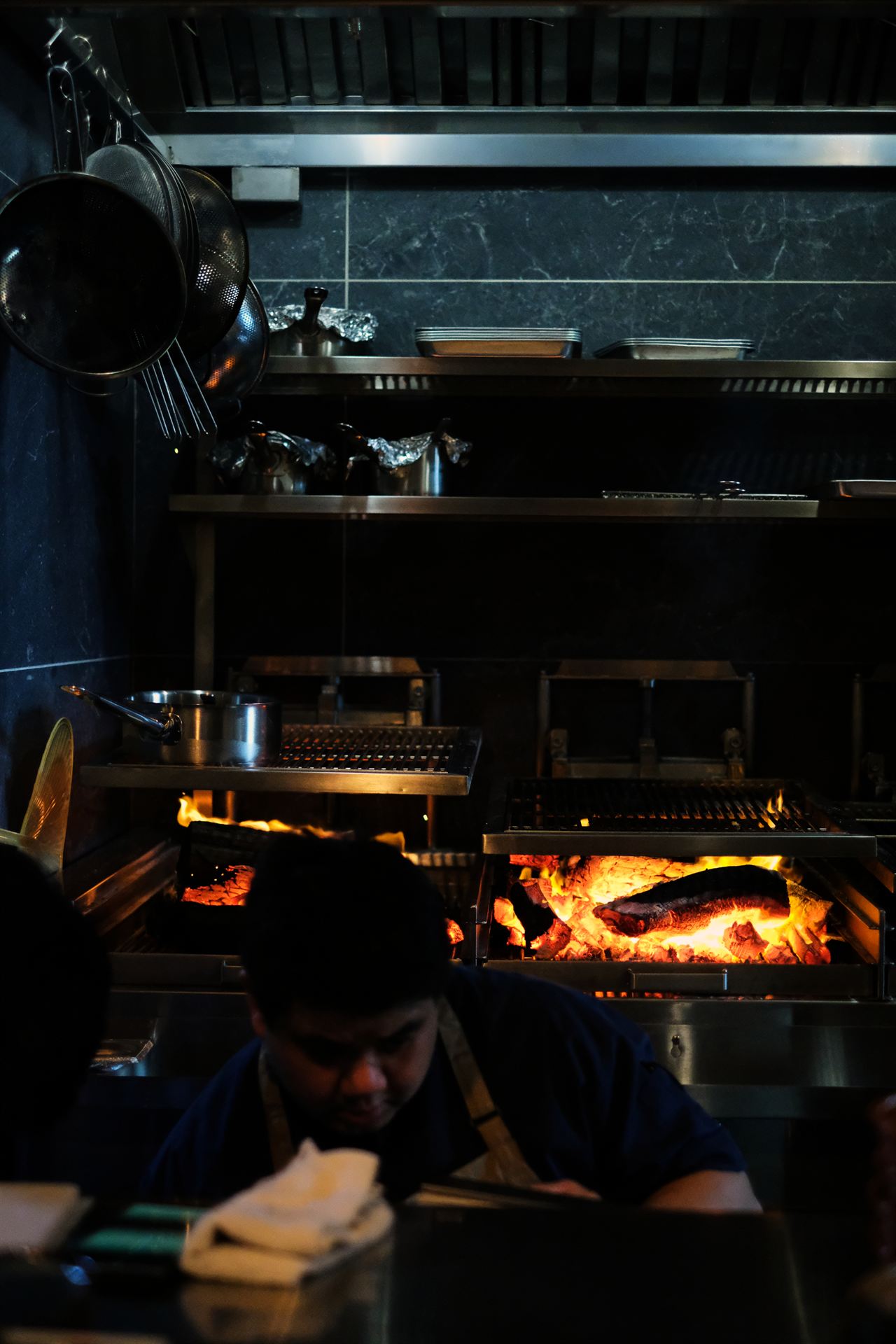
The photograph above is the fire at Hamilton Road, not the skewer counter at Haji Lane — no skewers in it, because there are none on that menu. And we are not claiming any of this makes us authentic to either tradition. What it makes us is a kitchen that noticed two cultures had independently arrived at the same tool — the argument set out properly in how the two halves of our menu fit together. We also serve pork and alcohol at both venues and are not halal; the practical questions are answered in our FAQ.
Where to eat which
Skewers are Haji Lane: Li’l Habibi, 55 Haji Lane, Singapore 189248, inside Bar Stories, Tuesday to Sunday 5.30pm–10.30pm, evenings only. The spatchcocked bird and the mezze are at 29 Hamilton Road, Jalan Besar, Tuesday to Sunday 5pm–11pm, brunch Saturday and Sunday 11am–2.30pm. For the three Japanese grill formats Singapore menus keep confusing, see yakiniku, yakitori and robatayaki; for the wider map, the full guide to Japanese food in Singapore. Otherwise: the menus, the grill, a table.
Sources
Etymologies, the Baghdad cookbook, the Adana and Persian skewer descriptions and the Turkish vegetable point are from Wikipedia’s articles on kebab and shish kebab; the marinade from jujeh kabab; shio, tare and the chicken-part names from yakitori; the 675 edict and its 1872 lifting from Buddhist vegetarianism. All read 8 September 2026; our own menu lines re-read from the live PDFs the same day.