
Babaganoush, Smoked Over Charcoal: What the Fire Actually Does to an Eggplant
How we build our babaganoush: a whole eggplant smoked over charcoal, a Japanese sesame sauce in place of tahini, and the crisp that keeps a dip interesting.

Babaganoush is the dish on our menu that looks least like fusion and has been rebuilt the most. It reads like a Levantine dip because it is one. Then you eat it and something is clearly Japanese about it, and it is not the thing most people guess.
The menu line is short: smoked eggplant, kinnogomadare, roasted sesame seeds, tempura, togarashi. Five things. Here is what each of them is doing, starting with the one everybody skips past.
The eggplant is the dish
An aubergine is mostly water held inside a sponge. That is the whole problem and the whole opportunity. Cook it gently and you get a bland, wet vegetable. Put it over serious heat and the sponge collapses, the water leaves, the sugars concentrate, and what is left behind is soft, dense and savoury in a way the raw vegetable gives no hint of.
The traditional method for a smoked aubergine dip is not complicated and has not changed in a very long time: the whole vegetable goes onto the fire, skin and all, and stays there until the skin is properly blackened and the thing has slumped in on itself. The blackened skin is not damage. It is the seasoning. As the skin splits, smoke gets in through the tears, and the flesh directly under the skin takes on the char.
Then it is scooped out and drained, and this is the step that separates a good version from a disappointing one. Cooked aubergine holds a surprising amount of liquid, and if that liquid stays in, you get a dip that slides off the bread and tastes of not very much. Everything that happens afterwards — the sauce, the seeds, the crisp — is being added to a base that has already done the heavy lifting.
What a charcoal fire adds that a gas flame cannot
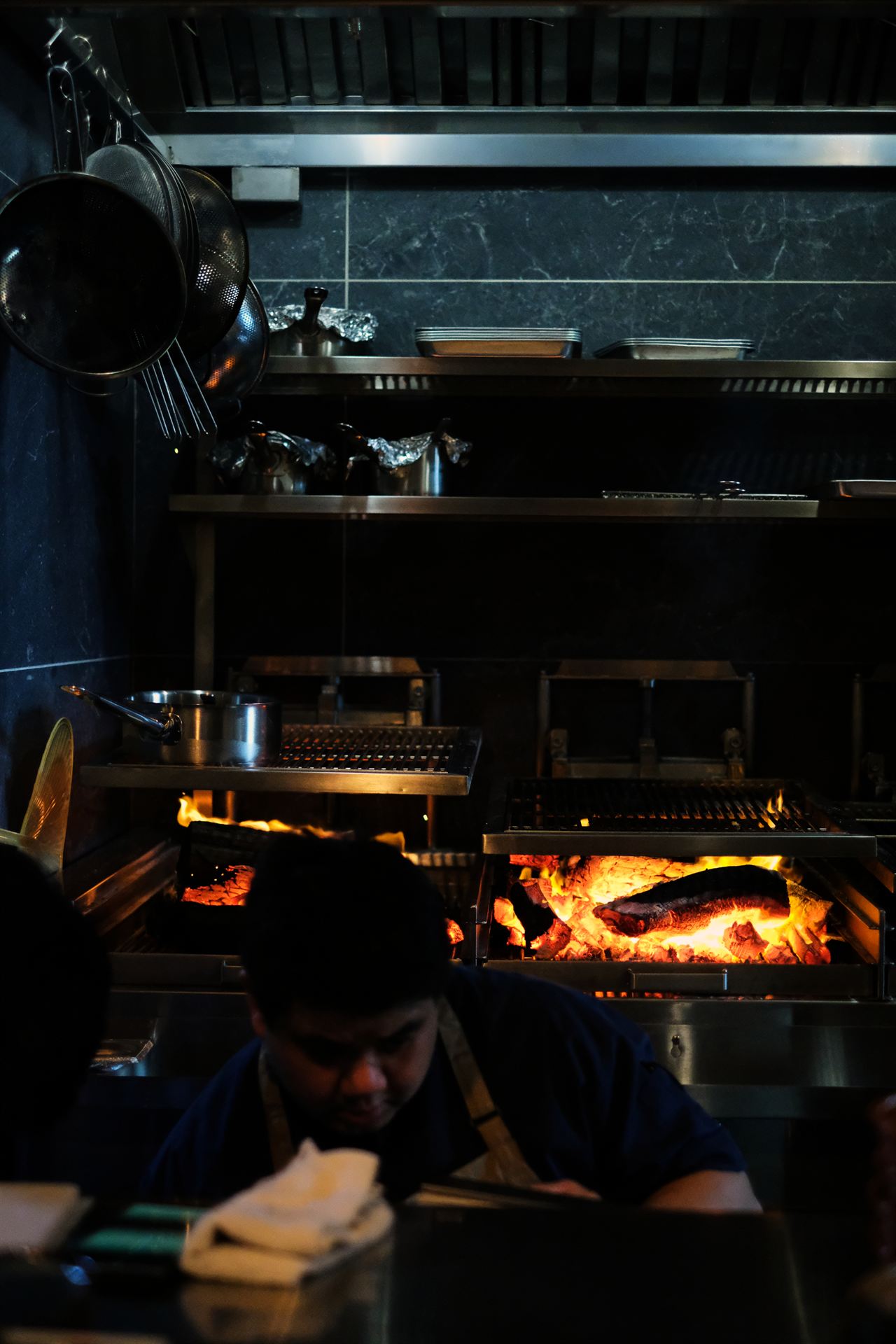
Our kitchen is built around an open charcoal grill. It is the first thing you see from the counter seats and it is the reason the room smells the way it does.
The difference matters here more than almost anywhere else on the menu. A gas flame gives you heat. Charcoal gives you heat, radiant char and smoke, and an aubergine sitting directly in that is absorbing all three at once through skin that is splitting open as it goes. Smoke is not a flavour you can add later from a bottle in any way that convinces. It has to happen while the vegetable is cooking, which means it has to happen on the fire.
The sauce, in one paragraph
Where a Levantine babaganoush would take tahini, ours takes kinnogomadare — a Japanese roasted-sesame sauce. Both are built on ground sesame, which is why the swap works at all and why the dip does not read as a gimmick. We have taken that sauce apart in full in its own piece, including what it does to a dip that used to be Lebanese, so we are not going to repeat it here. The short version: the sourness recedes and the savouriness comes forward.
Three garnishes, three separate jobs
The rest of the menu line is texture and lift, and each one is solving a specific problem that dips have.
Roasted sesame seeds. The sauce is already sesame, so this is the same note played dry and whole instead of ground and wet. It gives you something to find with your teeth and it keeps the sesame present at the top of the mouthful rather than only underneath it.
Tempura. Loose fried crisp, scattered over. A dip is soft the whole way down, and softness all the way through is the reason people stop eating a dip before the bowl is empty. Crunch resets the mouth. This is the single most underrated component on the plate.
Togarashi. Togarashi is simply the Japanese word for chilli. The blend most people have met is shichimi togarashi, the seven-spice mix that carries citrus peel and sesame alongside the chilli, and that citrus edge is doing as much work here as the heat is — smoked aubergine is rich and low and wants something bright landing on top of it. Our menu just says togarashi, so that is what we say too.
The Haji Lane version is a different plate
Our little sibling on Haji Lane runs a babaganoush too, and it is not the same dish. Same smoked eggplant, same kinnogomadare, same roasted sesame seeds — and then, in place of the tempura, keropok chicken skin.
Keropok is the Malay and Indonesian word for a puffed, fried cracker, the kind that shatters. Swapping the tempura for a chicken skin worked to that texture does two things: it makes the crisp savoury and animal rather than neutral, and it quietly makes the dish Southeast Asian at the exact point where the Hamilton Road version is Japanese. A Levantine dip, a Japanese sauce and a Malay-named crisp, in a shophouse in Kampong Glam. Nobody planned that as a statement. It is just what happens when a kitchen cooks where it stands.
That is the version you get at Li’l Habibi, 55 Haji Lane, from 5.30pm Tuesday to Sunday.
Is it vegetarian? Ask us
The Hamilton Road version has no meat in it. That is not the same as saying it is vegetarian, and we would rather be straight about why.
The standard base for a Japanese roasted-sesame sauce includes dashi, and dashi is usually made with bonito, which is fish. We do not publish our sauce build, so the useful answer is not a paragraph on a blog — it is the floor asking the kitchen on the night you are in. The menu says it plainly at the bottom of the page: please let us know if you have any dietary restrictions or food allergies. We mean it, and the answer you get will be the real one.
The Li’l Habibi version has chicken skin on it, so that one is settled.
How to order it
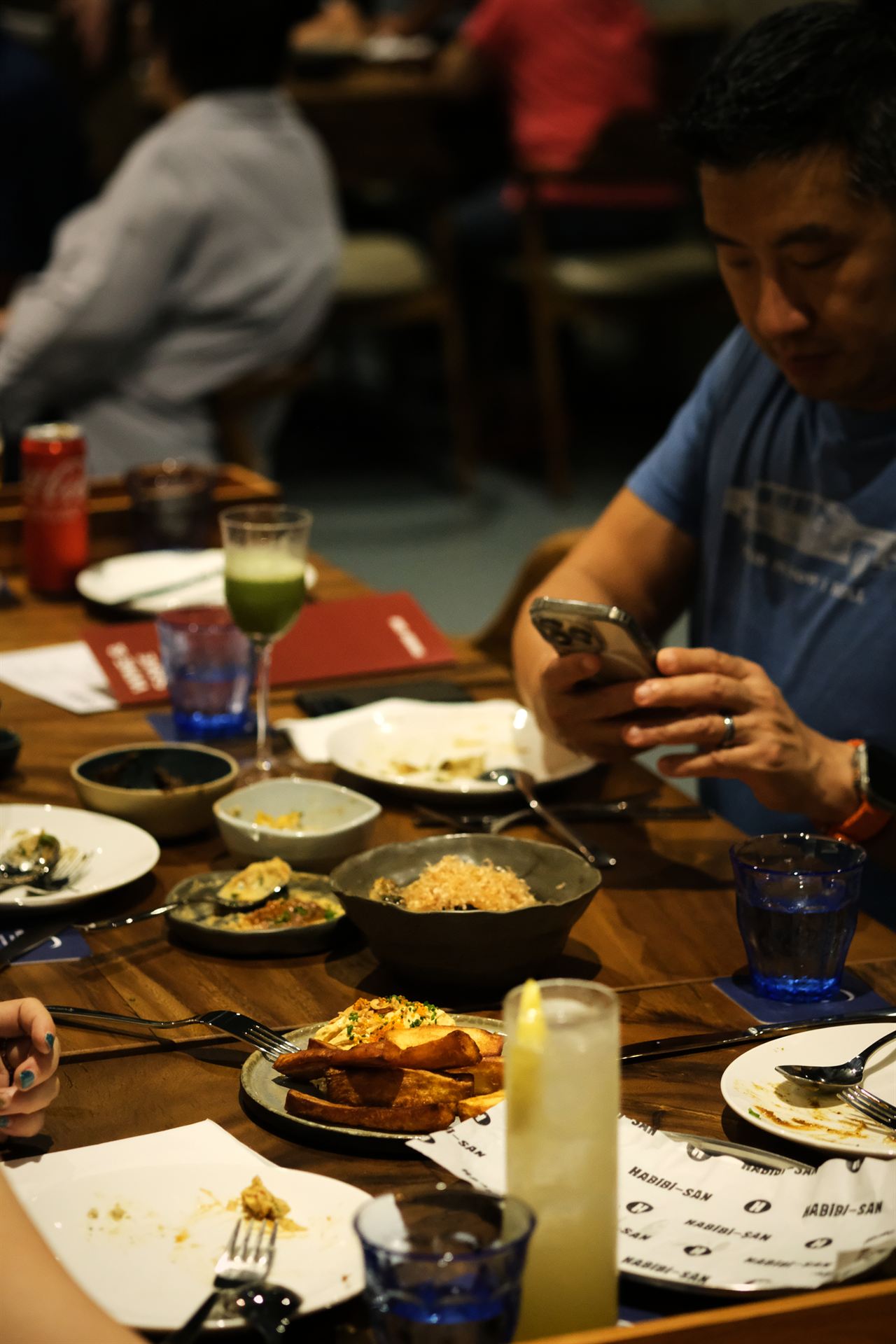
Babaganoush is mezze, and mezze is a plural format. One dip on a table is a starter; three or four dips on a table is the meal, and the point is that they should disagree with each other. Put the babaganoush next to the chickpea hummus, which is cool and dense and finished with salmon roe, and the matbucha, which is sweet-sharp stewed tomato and pepper. Smoky, cool, sharp. Add pita to move it all around.
If you are ordering one more thing after that, make it the Brussel sprouts, which run the same sesame sauce over the other most-charred thing we cook, or the cassava and taramasalata if you want the salty, fishy corner of the table filled in. What reviewers keep ordering is a decent shortcut if you would rather not decide.
Where to eat it
The full list is on the menu, there are photographs of the fire it comes off in the gallery, and the longer story of how a Levantine dip ended up with a Japanese sauce on it is in five years of Habibi-san. Two more dishes from the same kitchen worth reading first: the Mangalica pork collar and the fire-tossed edamame.
We are at 29 Hamilton Road, Singapore 209198, Tuesday to Sunday from 5pm, with brunch on Saturday and Sunday from 11am to 2.30pm. Book a table.