
Tahini, Explained: What It Actually Is and How It Is Made

Tahini is the most-used ingredient in Middle Eastern cooking that almost nobody can describe. It is in the cupboard. It is in the hummus. It is half the actual name of the dish. And ask ten people what it is made of and most will get as far as “sesame” and stop.
Here is the whole thing, including the manufacturing step that nobody expects, the reason two jars of it can taste completely different, and the point at which our own kitchen stops using it.
The word is a verb
Tahini comes from a colloquial Levantine Arabic pronunciation of ṭaḥīna (طحينة), or more precisely ṭaḥīniyya. It sits on the Classical Arabic root ط ح ن, Ṭ-Ḥ-N, which as a verb — ṭaḥana — means to grind.
So the name is not a description of a flavour or a plant. It is a description of a process. The thing is named after what was done to it, which is a good hint that the grinding is where the interesting part lives. The word had made it into English by the late 1930s.
How it is actually made, and the step nobody expects
Most people assume tahini is sesame seeds put through a grinder. That is the last step, not the process.
The seeds are first soaked in water and crushed — not to make paste, but to separate the bran from the kernel. The crushed seeds then go into a second soak, this time in water with a very high salt content. The salt makes the water dense enough that the bran sinks and the kernels float. The floating kernels are skimmed off the top, toasted, and only then ground into an oily paste.
That is a separation problem solved with a salt bath, and it is the reason standard tahini is smooth and pale rather than gritty and grey.
Two variables come straight out of that, and they explain why jars differ so much.
Hulled or unhulled. The common variety uses hulled seeds — the ones that went through the salt bath. Unhulled seeds can be used too, and the result is slightly bitter, but more nutritious. If a tahini has tasted harsh to you, that is not necessarily a bad jar; it may be a different jar.
Toasted or not. The kernels are normally toasted before grinding. Made with untoasted seeds, it is sold as raw tahini. Same seed, same process, a different ceiling on how dark and how nutty the finished paste can go.
Tahini paste is not tahini sauce, and the difference matters when you order
The jar is one thing. What arrives next to your falafel is another.
Tahini-based sauces are a standard side and garnish across Middle Eastern restaurants, and they are the paste loosened and seasoned — usually with lemon juice, salt and garlic, thinned with water. In the Levant that sauce is the main ingredient of tarator, which is what goes with falafel and shawarma.
This is the same relationship a Japanese kitchen has between a ground sesame paste and a finished, seasoned sesame sauce, and it is the exact distinction most menus blur.
The other sesame paste, and how far apart they really are
Sesame paste is used across East Asia too, and the honest summary is that it may differ only slightly from tahini. Where it does differ, it differs in one direction: Chinese sesame paste is made from roasted sesame, so it is much darker and has far less astringency.
That single line is the whole reason a Levantine dip and a Japanese sauce built from the same seed do not taste like relatives. Ours goes further than that, because the sauce we reach for is a finished seasoned tare rather than a paste — we have taken the Japanese golden sesame sauce apart in its own piece, including why it ends up under the most charred things on the menu, so it will not be re-argued here.
The paper trail is older than you would guess, and thinner than you would hope
Ground sesame turns up as a recipe in the tenth-century Arabic cookbook Kitab al-Tabikh, to be used as a condiment or eaten with bread. Tahini is named as an ingredient of hummus kasa in an anonymous thirteenth-century Arabic cookbook, the Kitab Wasf al-Atima al-Mutada. A fourteenth-century Hebrew work records people in the Middle East grinding sesame seeds and mixing them with date honey.
You will also see a claim that the oldest mention is a cuneiform document written four thousand years ago describing sesame wine served to the gods. We pass that on as a claim rather than a fact, because it is a long way from a paste in a jar to wine in a temple, and the leap is doing a lot of work.
One regional note worth knowing, because it never appears on menus outside the region: in the West Bank city of Nablus, tahina is mixed with qizḥa paste to make black tahina.
Where it is on our card, and the two places it deliberately is not
Our menu at 29 Hamilton Road touches sesame paste three times, and only one of them is tahini in the textbook sense.
- Chickpea Hummus — macadamia tahini, ikura. The sesame paste is cut with macadamia. That is a real departure and it costs us something specific; the full argument for the swap, and what goes back in to replace what it removes, is its own post.
- Fremantle Octopus — twice-cooked WA octopus, macadamia tahini, lime. The same paste, doing a completely different job.
- Babaganoush — smoked eggplant, kinnogomadare, roasted sesame seeds, tempura, togarashi. No tahini at all. The sesame arrives as a Japanese sauce instead.
That last one produces a genuinely odd result once you know the vocabulary, because the Levantine dish that is defined by mashed grilled vegetables plus tahini is not baba ghanoush at all — it is mutabbal. We worked that out in the hummus-versus-baba-ghanoush post, and the accident it produces on our own card is documented there rather than repeated here.
If you want to see how the sesame dishes sit against the rest of the spread, the ordering guide to the whole mezze section is the practical version. If the words on the card are the problem rather than the dishes, there is a glossary. And the one sauce on this menu that is Lebanese and unmodified in structure is the toum — which is garlic, not sesame, and belongs to the charcoal chicken.
Three corrections, because all three come up
It is not sesame oil. Oil is pressed and aromatic and used in drops; tahini is ground and used by the spoonful.
Halva is this. A sweet spread called ḥalawa ṭaḥīniyya — “sweet tahini” — is a type of halva. The confectionery and the dip are the same paste sent in opposite directions.
It is not a health food or a diet food, and it is not nothing either. Tahini is 53% fat, 22% carbohydrates, 17% protein and 3% water. In 100g it supplies 592 calories, and it is a rich source of thiamine. Those are the numbers; what you do with them is your business.
If you want the same treatment applied to the other misunderstood paste on this menu — the green one, which is usually not what it says it is — that is the wasabi post.
Sources
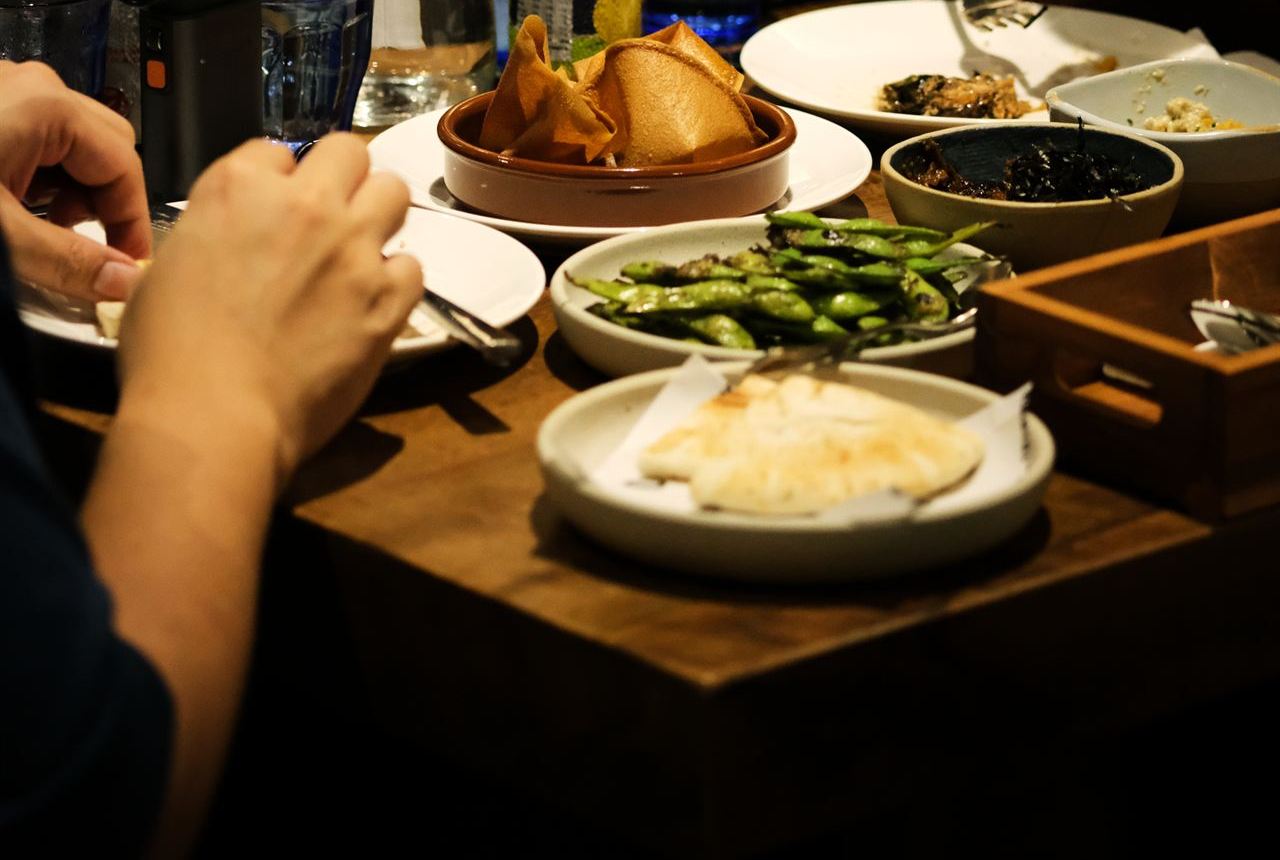
The etymology, the hulled-and-brine production method, the raw-tahini distinction, the tarator note, the Nablus black tahina, the cookbook datings and the nutrition figures are from Wikipedia’s article on tahini, read on 10 September 2026. Our own three menu lines were re-read from the live food-menu PDF the same day and are quoted as the card prints them. The photograph near the top of this post is our own mezze table mid-service, cropped to the food; two of the dips on our menu are built on sesame paste and neither of them is in the frame, because there is no photograph of tahini itself anywhere in our library.
We are at 29 Hamilton Road, Singapore 209198, in Jalan Besar — Tuesday to Sunday 5pm to 11pm, with brunch on Saturday and Sunday from 11am to 2.30pm. We serve pork and alcohol and are not halal. If you want this food somewhere other than here, we mapped Middle Eastern restaurants across Singapore beyond Arab Street. For the wider map, start with the full guide to Japanese food in Singapore. Otherwise: the menu, the room, and a table.