
Hummus vs Baba Ganoush: What’s the Difference?

They arrive in the same shape of bowl, at the same point in the meal, with the same bread. Both are beige. Both have a pool of olive oil in the middle. If you have ever pointed at one and got the other, you are not being careless — the two dishes are genuinely built to sit next to each other.
The short answer is chickpeas against eggplant. The useful answer is in the names, and it contains a fact that most menus in Singapore get backwards. Including, arguably, ours.
What the two names actually say
Hummus is not a description. The Arabic word literally means chickpeas. The full name of the dish is hummus bi tahina — “chickpeas with tahini”. So the sesame is not an optional extra in hummus; it is half the dish’s actual name. (Which does make “chickpea hummus”, as printed on our own menu, redundant. We have already owned up to that.)
Baba ghanoush is not a description either, and it is a much stranger name. Bābā is a term of endearment for “father”. Ġannūj may be a personal name. The combination gets rendered as “father of coquetry”, or “pampered daddy”, or “spoiled old daddy” — and it is not settled whether the father in question is a person at all, or the eggplant.
You will also see it written baba ganoush, baba ghanouj, and — on our card — babaganoush, one word. None of those is wrong.
The fact that reverses the usual explanation
Here is what almost every “what’s the difference” article gets the wrong way round. People assume both dips are defined by tahini. They are not.
Tahini is in hummus’s name. Baba ghanoush does not necessarily contain tahini at all. The Levantine dish that is defined by mashed grilled vegetables plus tahini has its own name: mutabbal. And Levantine mutabbal is not restricted to eggplant — it covers many vegetables.
So the tidy version people repeat — “one is chickpea dip with tahini, the other is eggplant dip with tahini” — describes hummus and mutabbal. If you have been served a tahini-heavy eggplant dip and told it was baba ghanoush, you were probably eating mutabbal, and nobody involved was lying.
Fire is the real dividing line
The difference that matters at the stove is not the vegetable. It is whether the dish is assembled or cooked.
Hummus is assembly. Chickpeas are boiled soft, then blended with tahini, lemon juice and garlic. Nothing in it is browned. The flavours are raw-side: sesame, acid, allium, fat. It is a dish about smoothness, and the technical arguments are about texture — how long the chickpeas cook, whether you skin them, how much you work the paste.
Baba ghanoush is cooking. The eggplant is traditionally roasted, baked or broiled over an open flame before peeling, so the pulp is soft and carries a smoky taste. The smoke is not a garnish or a seasoning added at the end; it is the point of the technique, and it is why the skin is burned and then thrown away. Everything else in the bowl is there to carry it.
Which is why one of these two dishes belongs to a charcoal kitchen and the other does not especially care. We have written at length about what an open fire does to an eggplant that a gas flame cannot, and about what fire is genuinely good at more broadly. A dense, sugary vegetable with enough surface area is close to the top of that list.
Which one is older, and the surprising part of the answer
Hummus has a documentary trail. The earliest known mention is a thirteenth-century Syrian cookbook attributed to the Aleppan historian Ibn al-Adim. That recipe has chickpeas, lemon, sesame and olive oil — and no garlic. Fourteenth-century Cairo cookbooks record it too, also without garlic.
Then the trail goes cold. According to the food historian Nawal Nasrallah, no recipes for hummus survive from after the fourteenth century until an 1885 Lebanese cookbook — by which point garlic had become standard.
So the garlic, which most people would name as one of hummus’s defining ingredients, is the newest thing in the bowl by roughly six hundred years. Baba ghanoush has no comparable paper trail; it is recorded as a Levantine dish without a dated first appearance of the same kind. Old food is often less documented than we would like, and the honest position is that the cookbook record tells you what got written down, not what people ate.
So which should you order?
If you are ordering one: hummus is the anchor. It is the mildest, the most forgiving, the one everyone at the table will eat, and it is the right thing to have on the board when the rest of the order is loud.
Baba ghanoush is the one with an opinion. Smoke, bitterness from the skin, a looser and more fibrous texture. It is better next to something acidic and worse as a peacekeeper.
If you are ordering both — which is what we would do at a table of three or more — treat them as a contrast rather than as two dips. Put something sharp between them. How many plates a board actually needs is a question we answer separately, and the short version is that people consistently under-order the bread.
Ours are not textbook versions, and by accident one of them is more orthodox than most
Our chickpea hummus comes with macadamia tahini and ikura — the sesame paste is cut with macadamia, and the garnish is salmon roe rather than paprika and parsley. That is a clear departure and we are not going to pretend otherwise.
Our babaganoush is smoked eggplant with kinnogomadare, roasted sesame seeds, tempura and togarashi. Note what is not in that list: tahini. The sesame arrives as kinnogomadare, a Japanese golden sesame sauce, which is a different preparation from a Levantine sesame paste.
Which produces a genuinely funny result. By the distinction above — baba ghanoush does not necessarily have tahini, mutabbal does — our tahini-free version has a better claim to the name baba ghanoush than half the tahini-loaded bowls sold under it. We did not do that on purpose. We did it because kinnogomadare is the sauce this kitchen reaches for, and the accident is only visible from the etymology.
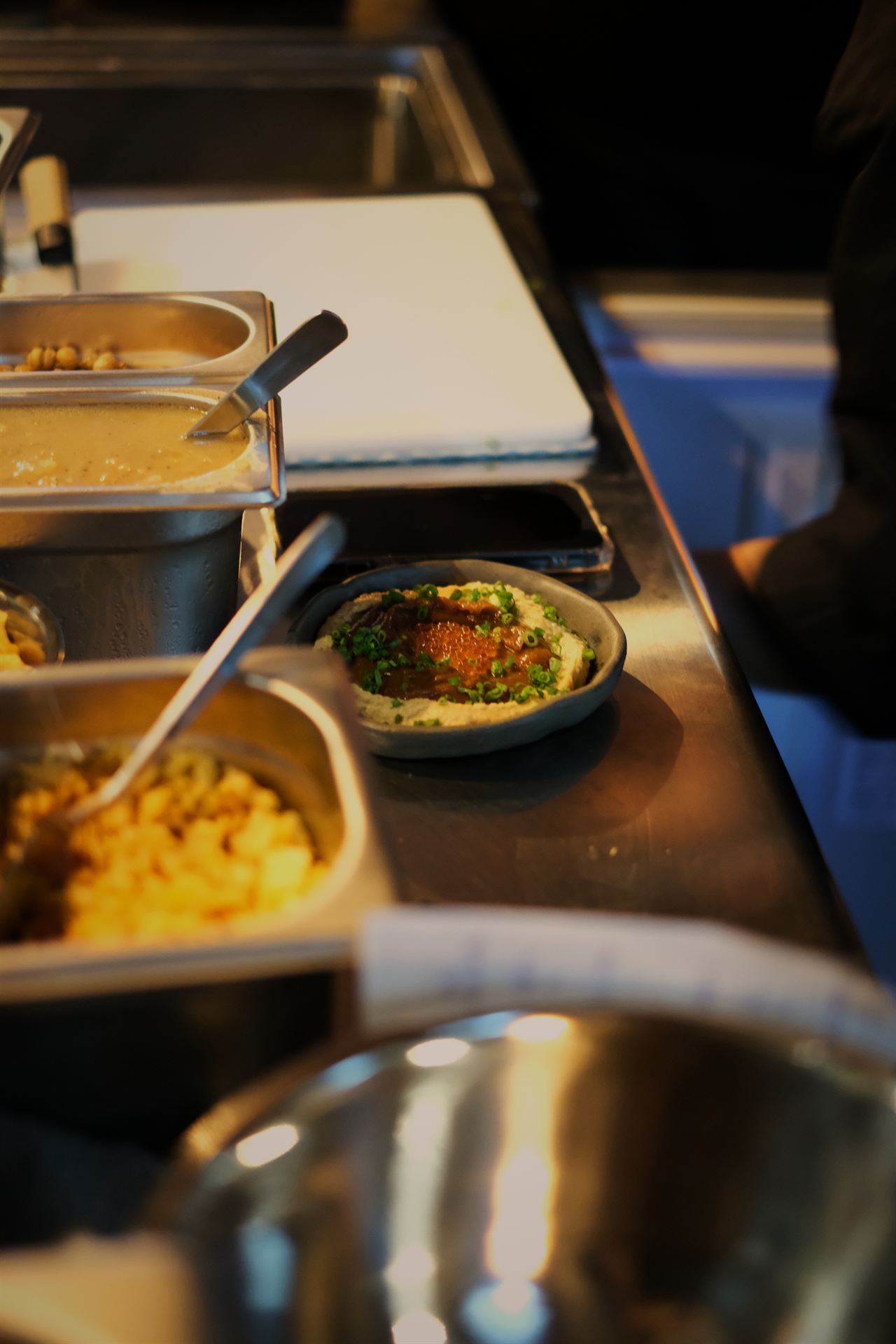
The photograph above is the hummus, on the pass, with its roe and chives. The babaganoush is not in the frame — it is a darker, looser bowl and it photographs badly, which is its own small argument for ordering it rather than looking at it.
Practical notes
Both are on the mezze section at 29 Hamilton Road, Jalan Besar — Tuesday to Sunday 5pm–11pm, brunch Saturday and Sunday 11am–2.30pm. The Haji Lane board at Li’l Habibi runs a different babaganoush and adds a mentaiko taramasalata. Garlic, incidentally, is its own subject on this menu: our garlic-yuzu toum is a Lebanese sauce that goes with the charcoal chicken, not with either of these. If the rest of the card is throwing words at you, there is a glossary.
We serve pork and alcohol and are not halal; the practical questions are in the FAQ. For the wider map, start with the full guide to Japanese food in Singapore. Otherwise: the menus, the room, and a table.
Sources
Etymologies, ingredients, the mutabbal distinction, the cookbook datings and Nawal Nasrallah’s note on the gap in the record are from Wikipedia’s articles on hummus and baba ghanoush, both read on 8 September 2026. Our own two dishes were re-read from the live food-menu PDF the same day and are quoted as the card prints them.