
Fire-Tossed Edamame: Why the Sauce Goes on the Part You Don’t Eat
The seasoning on edamame goes on the pod you throw away. How shiro miso, confit garlic butter and an open charcoal fire make that one second of contact count.

Here is the strange thing about edamame, and it is true of every edamame ever served, not just ours: the seasoning goes on the part you throw away.
You do not eat the pod. You put it in your mouth, drag it through your teeth, and drop it in the bowl. Whatever is on the outside of that pod has about one second of contact with your tongue, and then it is gone. Every decision in this dish follows from that one constraint.
Our version reads: fire-tossed edamame — shiro miso, confit garlic butter. Three words of technique and two ingredients, and all of it is aimed at that one second.
What edamame normally is
Edamame are immature soybeans, harvested green while the beans are still soft and sweet, and served in the pod. The standard treatment is boiled or steamed, then salted, then eaten warm or cold. In Japan it is the default otsumami — the snack that arrives with the first drink, before anyone has decided what they actually want.
Notice that the classic version already uses the trick. Coarse salt on the outside of a pod nobody eats is not a mistake; it is the whole design. The salt is a delivery mechanism, and the pod is the spoon. We did not invent the idea. We just stopped stopping at salt.
“Fire-tossed” is a literal description
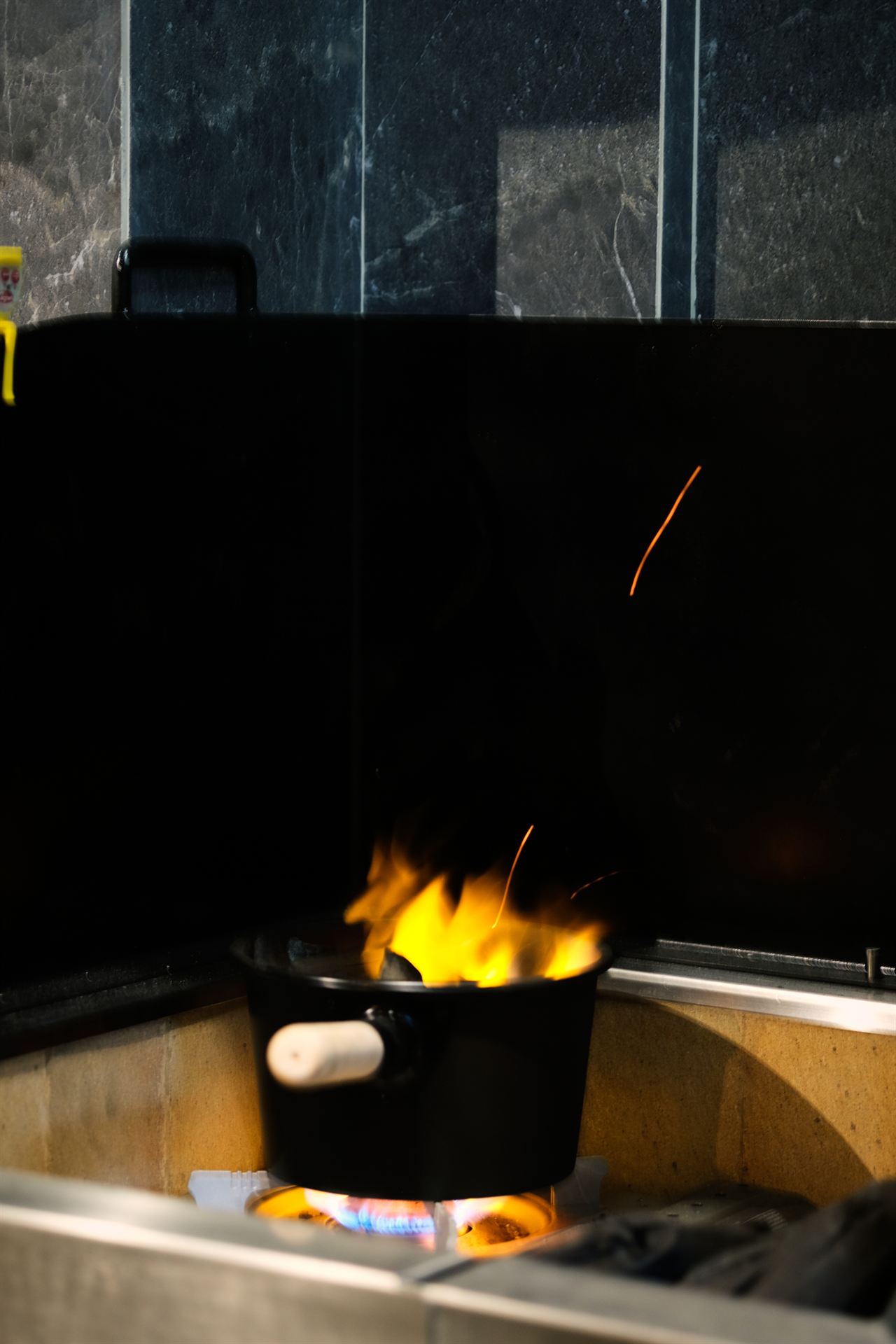
Our kitchen is built around an open charcoal fire, and the pods go over it hot enough to blister.
What that does to a bean pod is worth spelling out. The skin is thin and slightly damp, so real heat hits it fast: it puffs, it blisters, and it picks up black spots where it has touched metal or flame. The pod’s own sugars catch and darken. You get a faint, genuinely bitter char on the outside, and the beans inside steam in their own moisture rather than in a pot of water, which keeps them firmer and sweeter than a boiled pod ever manages.
Then it is tossed, while it is still hot, through the butter. Hot pod, cold-ish fat, thirty seconds of agitation, and the fat clings to a blistered surface in a way it would slide straight off a smooth boiled one. The char is not just flavour. It is grip.
Why shiro miso instead of salt
Shiro miso is white miso, and the difference from the dark stuff is not colour, it is proportion and time.
Miso is soybeans, salt and rice koji fermented together. Shiro miso uses a much higher ratio of rice to beans — roughly sixty per cent rice to forty per cent soybean — and it is fermented briefly, on the order of a week or two rather than the six months to a year that red miso takes. It is also kept warm while it ages, which converts the rice starch into sugar in much the same way amazake is made. The result is pale, mild, low in salt by miso standards, and distinctly sweet. Kyoto’s saikyo miso is the famous example of the style.
Against a pod, that beats salt on three counts:
- It is not one note. Salt is salt. Shiro miso brings salt, sugar and the deep savoury hum of a fermented soybean at the same time, which is three flavours in the same one-second window.
- The sugar meets the char. Blistered pod is bitter at the edges. Sweetness is the correct answer to bitterness, and it is a far better answer than more salt.
- It sticks. This is the practical one. Dry salt bounces off and ends up in the bottom of the bowl. A paste suspended in butter holds onto a blistered skin and stays there until your teeth arrive.
Confit garlic, not raw garlic
To confit something is to cook it slowly, submerged in fat, at a low temperature. It is a preservation technique that turned into a flavour technique, and garlic is the ingredient it transforms most completely.
Raw garlic is aggressive. The sharp, hot, slightly metallic bite comes from sulphur compounds that form the moment a clove is cut or crushed, and they are volatile and unsubtle. Cook garlic slowly in fat and those compounds break down; what is left is soft, sweet, faintly nutty and closer to a roasted vegetable than a seasoning.
Which is precisely why it belongs here and raw garlic would not. Raw garlic would fight the miso for the front of the mouth and win, and it would clash with the char rather than sit under it. Confit garlic joins the two together instead, and because it is already suspended in fat, it arrives on the pod without any extra work.
The fat itself is butter, and butter is not an afterthought in this dish — it is the vehicle. Miso will not coat anything on its own. Butter carries the miso, the garlic and the salt onto the pod as one film and then melts on contact with your mouth, which is how all of it comes off in the second you have available.
Eat it badly on purpose
The single most common way to under-enjoy this dish is to be polite with it. If you open the pod with your fingers and tip the beans out, you have thrown away everything we did.
Put the whole pod in, close your teeth, and pull. You want the butter, the miso and the char stripped off the outside on the way through. The beans are the texture; the pod is the flavour. Have a napkin.
Two honest notes: there is butter in it, so it is not vegan, and it is soy from top to bottom — the beans, the miso and the pod are all the same plant.
The other charred vegetable
This dish and the Brussel sprouts are the same problem solved two different ways. Both are vegetables taken to the point where the char turns properly bitter. The sprouts answer that with a roasted sesame sauce, which meets bitterness with more toasted bitterness and a lot of savoury weight. The edamame answers it with fermented sweetness and fat.
Neither is a compromise, and eating them in the same sitting is the fastest way to understand how this kitchen thinks. Add the babaganoush and you have three charred vegetables and three completely different sauces on one table, which is roughly the whole thesis.
Order it first
Edamame is the thing you order before you have decided anything else. It comes out fast, it is the cheapest way to find out whether the fire in this kitchen is doing something you like, and it keeps a table busy while the mezze is still being argued about — the hummus and the rest of the dips are the next decision, and the kibbeh nayyeh if anyone at the table is up for raw lamb.
The full list is on the menu, the fire is in the gallery, and the story of the kitchen that put miso on a soybean pod is in five years of Habibi-san. Our Haji Lane sibling, Li’l Habibi, runs a different snack list off a different fire.
We are at 29 Hamilton Road, Singapore 209198, Tuesday to Sunday from 5pm, with brunch on Saturday and Sunday from 11am to 2.30pm. Book a table.
The other salty thing that arrives before anybody has decided anything is the smoked olives — same job at the start of a table, an entirely different route to getting flavour onto something small.